
How to Rank in the Top 3 on Google Maps for Free in 2026
What if you woke up tomorrow and your phone was already ringing with qualified leads from Google Maps? No ad clicks. No referrals. No agency retainer. Just local customers searching for what you do and finding your business at the top. That is what ranking in the top 3 on Google Maps can do for a local business.
A lot of business owners have already tried to “do SEO” and got nowhere. They hired an agency, paid thousands, waited months, and still did not show up in the map pack. Meanwhile, a competitor down the street kept collecting free leads every day. The difference usually is not that the competitor is working harder or spending more. It is that they understand what Google actually uses to rank local businesses.
The good news is that local SEO is a lot simpler than most people think. Google Maps rankings come down to three main factors: relevance, distance, and prominence. Once you understand those three factors, the rest starts to make sense.
The 3 Google Maps Ranking Factors That Actually Matter
1. Relevance
Relevance is how closely your business matches what someone is searching for. If you are a plumber but your Google Business Profile does not list “water heater repair” as a service, then Google has less reason to show you for that search. Google cannot rank you for services it does not clearly see on your profile.
This is where a lot of businesses lose easy opportunities. They offer the service, but they never clearly list it in their profile. That makes them invisible for searches they should be showing up for.
2. Distance
Distance is based on how far your business is from the person doing the search. You cannot change your physical location, but you can improve how broadly you rank by strengthening the trust signals around your business. That includes the consistency of your profile, your site, and your overall local presence.
3. Prominence
Prominence is how established and trusted your business looks online. Reviews matter, but they are only one piece of the puzzle. Google also looks at your website, your business listings across the web, and how consistently your business information appears everywhere.
This is why local SEO is easier than traditional SEO. You do not need to outrank giant national brands. You just need to beat the local competitors in your market, and most of them are not even getting the basics right.
Start With Your Google Business Profile Categories
One of the highest-leverage fixes you can make is updating your Google Business Profile categories. Most businesses barely use them. Google gives you multiple category opportunities, but a lot of owners only fill out one or two and stop there. That is a mistake.
Your categories tell Google what your business is and what searches you should appear for. If you are only using the most obvious category, you are leaving money on the table.
Think through every meaningful service you offer. If you are a plumber, you might not just be a plumber. You might also fit searches tied to emergency plumbing, water heater services, drain work, and more. The point is to make your profile accurately reflect the range of work you actually do.
Build Out Your Services List the Smart Way
Once your categories are in better shape, move to your services list.
A simple way to improve this fast is to search for your service in your city and look at the businesses ranking in the top 3 on Google Maps. Click their profiles and see what services they have listed. If they offer the same services you do, add those services to your own profile using the same language, as long as it is truthful.
Why does this work? Because Google is already associating those phrases with businesses it trusts and ranks. You are not guessing. You are aligning your profile language with what Google is already rewarding.
Post on Your Google Business Profile Regularly
Most business owners do nothing with their profile after setting it up. That is why posting regularly can help you stand out.
A simple system is enough. Make a list of your top five services. Record a short 30-second tip about each one on your phone. Then post those videos to your Google Business Profile with a simple caption explaining the problem you solve. Do it once a week. That is enough to show activity and make your business look more engaged and trustworthy to both Google and potential customers.
This does not need to be polished. It just needs to be real and consistent.
Create a Real Review Request System
Everybody knows reviews matter. Very few businesses have a system for getting them.
The easiest method is often the best one: send a personal text from your own phone within 24 hours of finishing the job. Thank the customer and ask for a quick review, then include your review link. That works because it feels personal, the experience is still fresh, and it takes almost no effort for the customer to follow through.
Without a system, you are just hoping happy customers remember to leave a review on their own. Most will not, not because they disliked your service, but because life gets busy.
Optimize Your Business Description With AI
Your Google Business Profile description is another easy win. It does not need to be complicated.
You can use a free AI tool to draft a clean description that includes your business name, year founded, main services, and service area, while staying under Google’s character limit. Then edit it so it sounds natural and accurate to your business.
This takes minutes, and it helps reinforce relevance.
Make Your Website and GBP Match
This is where most businesses break the chain.
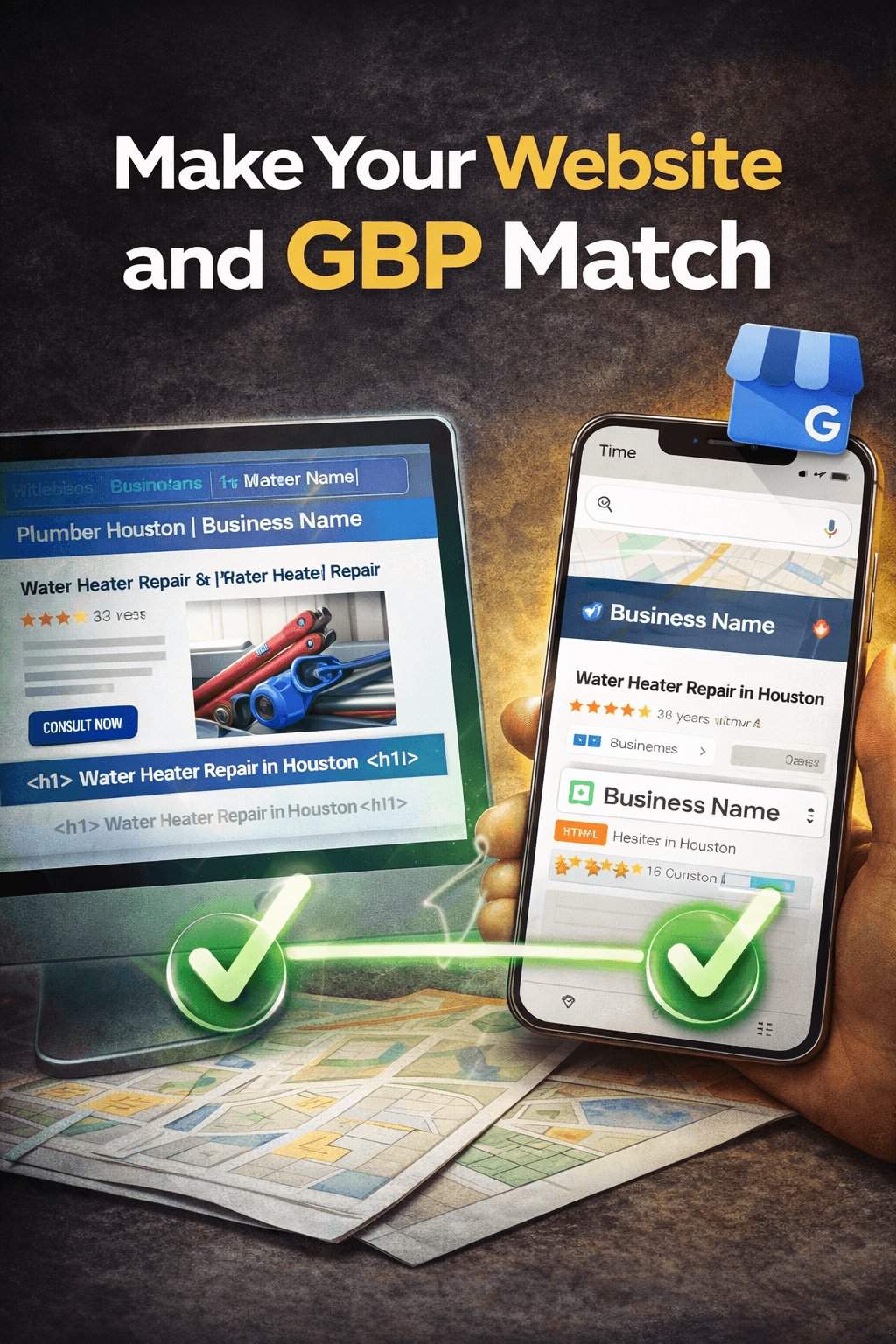
Your Google Business Profile and your website should be reinforcing each other. Instead, most local businesses have a profile saying one thing and a website saying something else. Google sees that disconnect.
Start with your homepage title tag. If it just says “Home” or only your business name, you are wasting valuable real estate. Your homepage title should clearly state your main service and your city. For example: “Plumber Houston | Business Name.” That helps Google connect your site to your profile and your main local search intent.
Your homepage content should follow the same logic. Every major Google Business Profile category and service you added should have matching language on the page. If your profile says “water heater installation,” your website should say that exact phrase, not some creative variation. Google rewards clear consistency.
Add These 3 Things to Your Homepage
Once your homepage language aligns with your profile, add three more elements:
1. Embed Your Google Map
Adding your Google Maps listing to your homepage helps reinforce your location and supports the distance signal.
2. Show Your Google Reviews
Displaying reviews on your homepage adds social proof and strengthens trust for both Google and human visitors.
3. Add Local Business Schema
Schema sounds technical, but it is just code that tells Google what your business is, where it is located, and what it does. You can generate a basic local business schema block with a free AI tool, test it with Google’s schema testing tools, fix any errors, and then add it to your homepage header.
That is a straightforward way to strengthen prominence.
The Real Goal: Build the Right Foundation
If you want to rank in the top 3 on Google Maps for free in 2026, the basics matter more than people want to admit.
You need:
a fully built-out Google Business Profile
accurate categories and services
steady activity on your profile
a simple review system
a homepage that matches your GBP
local business schema
clear location signals
That is your foundation. And the businesses that dominate local search usually are not doing magic. They are just doing the right things in the right order.
Final Thoughts
If your business is not ranking well on Google Maps, do not assume you need more expensive tools, more agency retainers, or more ad spend. In a lot of cases, you just need tighter alignment between your Google Business Profile, your website, and the way Google reads both.